
Executing Justice & the Southern Lost Cause
from an exposition of Jeremiah 21

Jeremiah 21 records one of the hardest words God ever sent to Judah’s rulers: “Execute justice in the morning, and deliver from the hand of the oppressor him who has been robbed” (Jeremiah 21:12). Micah says the same thing even more simply: “What does the LORD require of you but to do justice, and to love kindness, and to walk humbly with your God?” (Micah 6:8). God’s people are commanded not merely to speak about justice, but to do it—to protect the robbed, the weak, the oppressed, and the unseen.
When We Were the Bad Guys
I am from the South, from Alabama, the Southest of the South. As a teenager, I was a member of the Sons of Confederate Veterans. I researched and found my great-great-whatever-grandfather’s induction records into the Confederate army. When I was in seminary in California, I had a Confederate flag on my wall, telling every visitor where I was from. I am still proud of being from the South—the food, the culture, the football, the improved English. But as I became more aware of the racism, and then, after a long time, after learning about Alexander Stephens’ Cornerstone Speech, it finally crystallized in my mind: we were the bad guys.
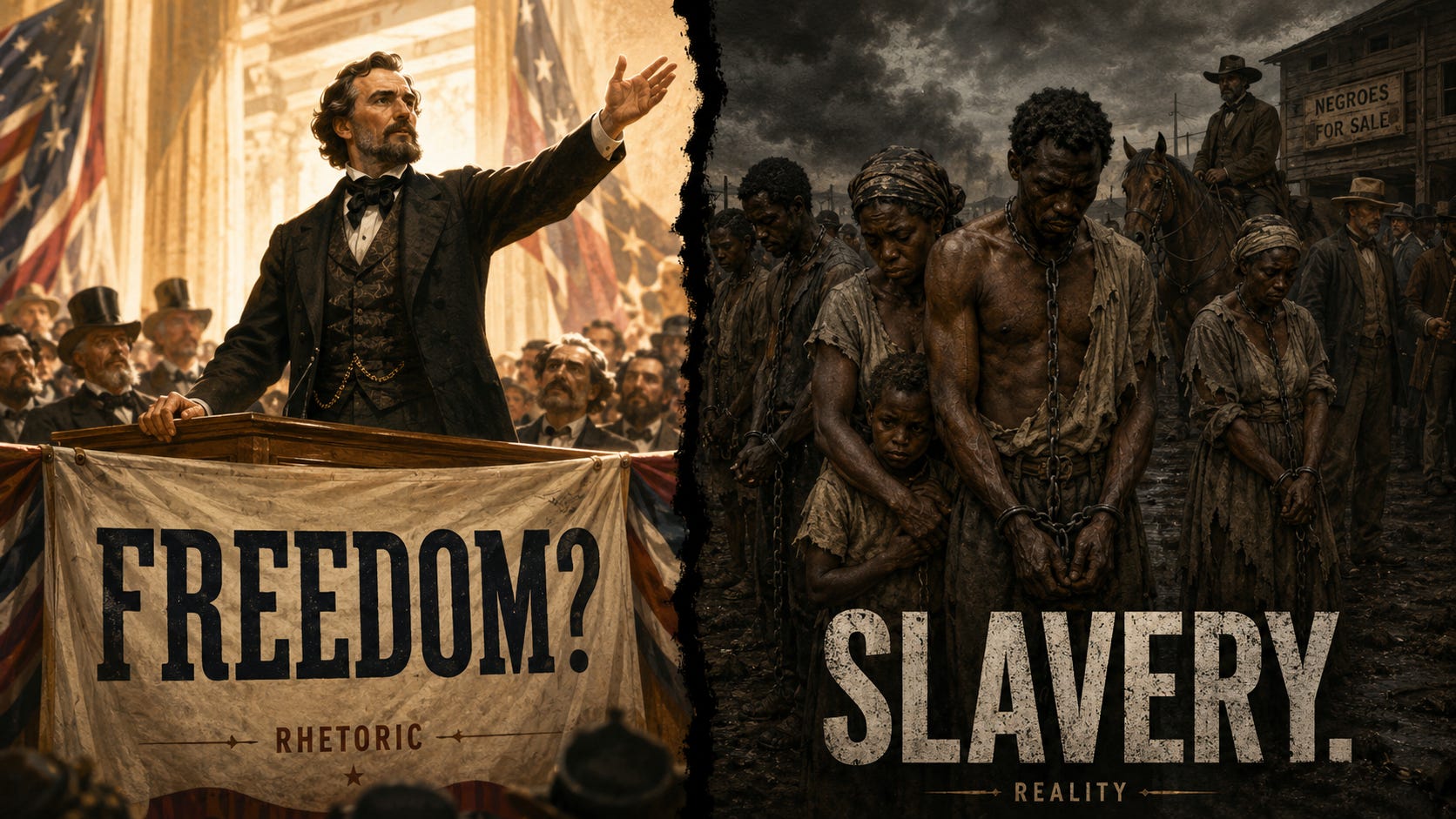
The South could claim to fight for “freedom” only because it did not see the people it enslaved as fully equal human beings. Alexander Stephens, vice president of the Confederacy, said this plainly in Savannah, Georgia, on March 21, 1861: “Our new government is founded upon … the great truth that the negro is not equal to the white man; that slavery[,] subordination to the superior race[,] is his natural and normal condition.” Once you stop seeing people as people—or once you define them as natural subordinates—you can stop doing justice and still imagine yourself righteous.
The Lost Cause’s Bait-and-Switch
Some defenders of the Old South cover this with a bait-and-switch. They point to biblical regulations of Israelite debt-servitude and conclude, “See, slavery is not necessarily sinful.” Then they smuggle that conclusion into the Old South. But Exodus 21’s servitude was not racial, hereditary, perpetual chattel slavery. Hebrew servants were to be released in the seventh year (Exodus 21:2; Deuteronomy 15:12). In Jeremiah’s day, one of Judah’s sins was that they had released their servants and then treacherously enslaved them again (Jeremiah 34:8–17). They robbed them of the freedom God’s law required.
Southern slavery was different. It was race-based, inherited, lifelong, and rooted in man-stealing—the very crime Exodus 21:16 condemns with death: “Whoever steals a man and sells him, and anyone found in possession of him, shall be put to death” (Exodus 21:16; see also 1 Timothy 1:10). That is not the same institution under a different name. It is a different thing morally, legally, and covenantally.
I run across the same kind of category trick when debating icons. Defenders of icon veneration will sometimes suggest that all images—art, decoration, temple ornament, and devotional icons—belong to the same category. Then they argue that because the Old Testament permitted artistic images in the tabernacle and temple, it must also approve religious veneration of icons (Exodus 25:18–22; 1 Kings 6:29). But that does not follow. A carved cherub over the mercy seat is not the same thing as an icon bowed before in worship. Likewise, the Old Testament’s regulated debt-servitude is not the same thing as the Old South’s racialized chattel slavery. That is not exegesis. It is a category trick.
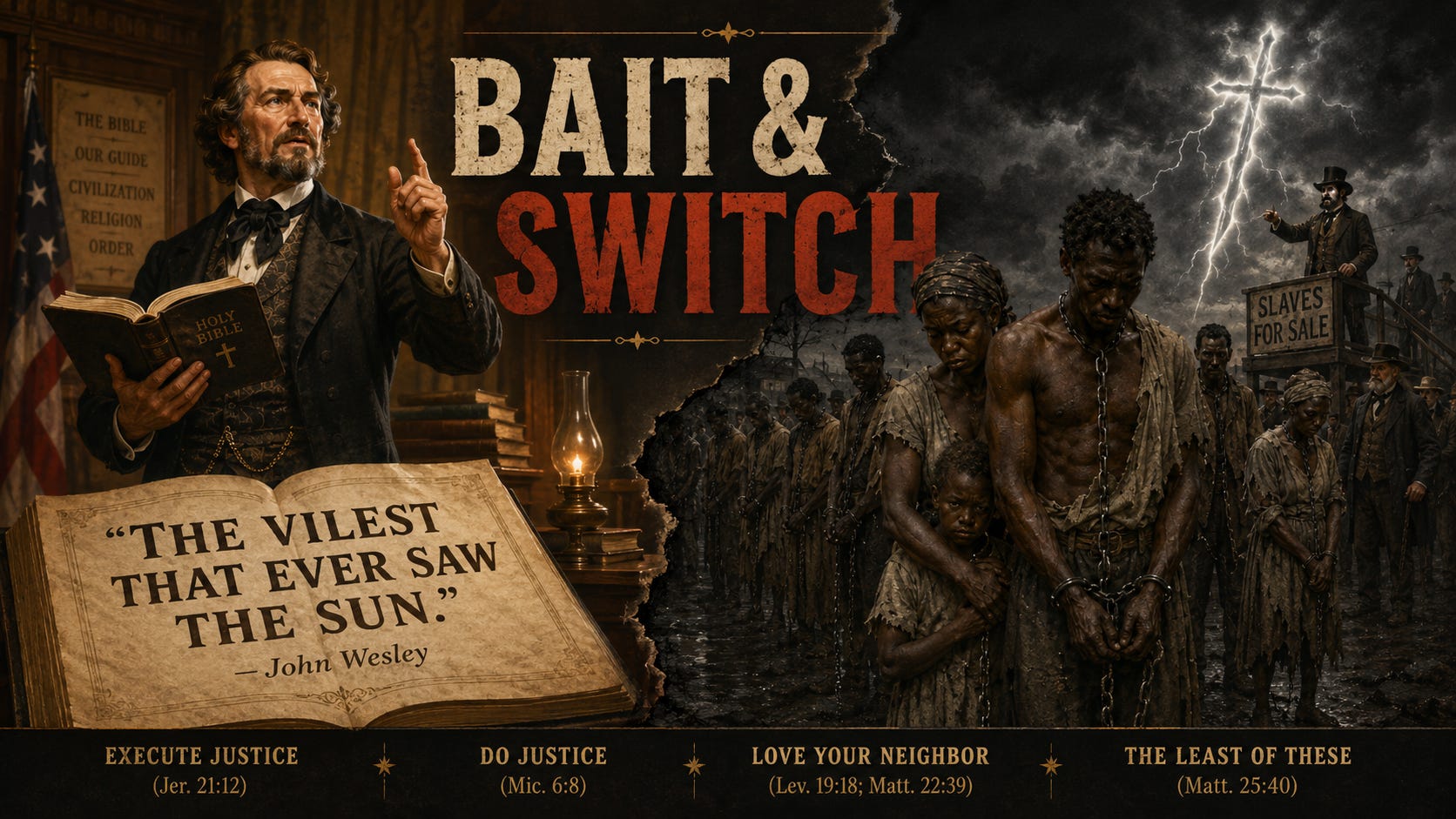
It is a bait-and-switch. We are baited with reverence for Scripture, and then the object is switched. We are asked to approve, or at least soften our judgment of, Southern slavery because the Bible regulated something also called “slavery.” But the differences are so great that we should almost use different words. John Wesley called American slavery “the vilest that ever saw the sun.” God said to Southern slaveholders, “Execute justice” (Jeremiah 21:12), “Do justice” (Micah 6:8), “Love your neighbor as yourself” (Leviticus 19:18; Matthew 22:39), and remember that what you do to “the least of these” you do to Christ Himself (Matthew 25:40). They did not listen. And so God loosed the fateful lightning of His terrible swift sword.
The Person We Refuse to See
And now we are doing it again.
We think that if we can refuse to see a certain kind of person as a person, we can deny them justice. Just call them a clump of cells. Then we can kill them by the millions and assure ourselves that we are not the bad guys.
Abby Johnson was a clinic director for Planned Parenthood in Bryan, Texas. In September 2009, as she later recounted, she was asked to assist with an ultrasound-guided abortion. She saw a thirteen-week-old unborn child on the monitor recoil and struggle against the suction device before being dismembered. And it occurred to her: that was a person. She left her job and sought help from the pro-life people who had often prayed outside her clinic.
That is the issue. Justice begins when we see the person God has placed before us. The image of God is not granted by race, class, usefulness, size, independence, or power. It belongs to human beings because God made them (Genesis 1:26–27; Genesis 9:6; James 3:9). The unborn child is our neighbor (Luke 10:25–37). The oppressed servant is our neighbor. The weak, the robbed, the unwanted, and the unseen are our neighbors.
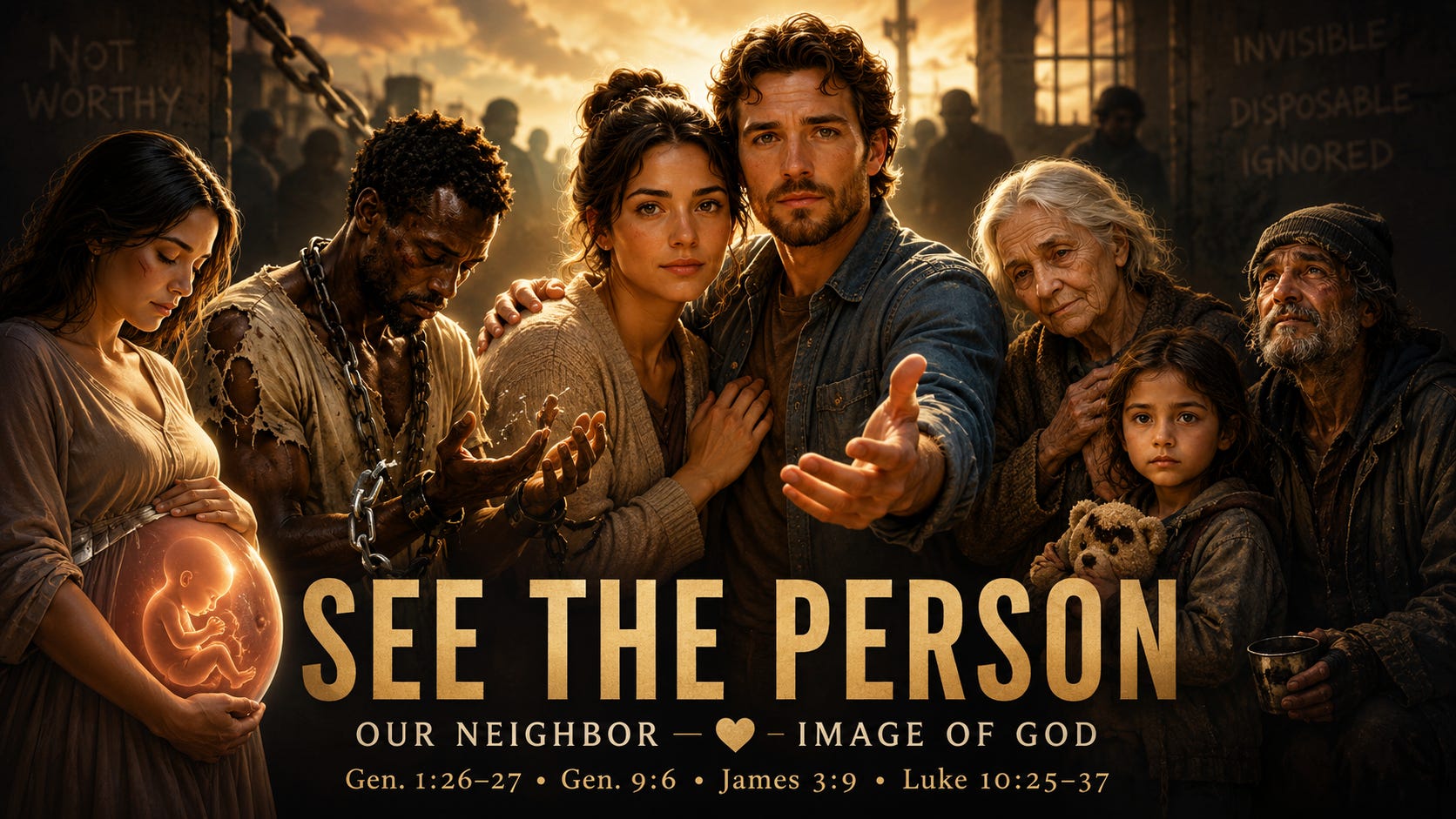
God commands us to execute justice for whoever is being robbed—of life, of freedom, of dignity, of what God has given them. And if we do not, God still has His terrible, swift sword. “Thus says the LORD: Execute justice in the morning, and deliver from the hand of the oppressor him who has been robbed” (Jeremiah 21:12). “He has told you, O man, what is good” (Micah 6:8).
To hear the full exposition of Jeremiah 21, click and listen:
Covenant Reformed Baptist Church is Caswell County’s & Danville’s Reformed church.