
The Problem with Deaconism
a new article in Theopolis

I’m not a stickler for polity. I say “amen” to Mark Dever’s exaltation of congregationalism, but I’m not as passionate about it as he is. I’ve read Jay Adams on the nuts and bolts of presbyterianism and been impressed; I even pastored a church claiming that polity, although independent (thus “presbyterial”). I read John Stott championing episcopacy and thought, “He has good points.” The Lord Jesus and His Apostles didn’t give us bylaws for a polity but principles that a good polity should fulfill, especially being able to follow Jesus’ instructions about church discipline (Matthew 18:15-18). Any good polity should be able to apply Jesus’ steps to any member of the church, including those at the very top. If a polity has a strip-mall “apostle” who cannot be held accountable, it’s defective. If a polity can faithfully model Jesus’ design for leadership and doesn’t contradict any scripture, I can work with it. But there is one polity that deserves universal scorn: deaconism.
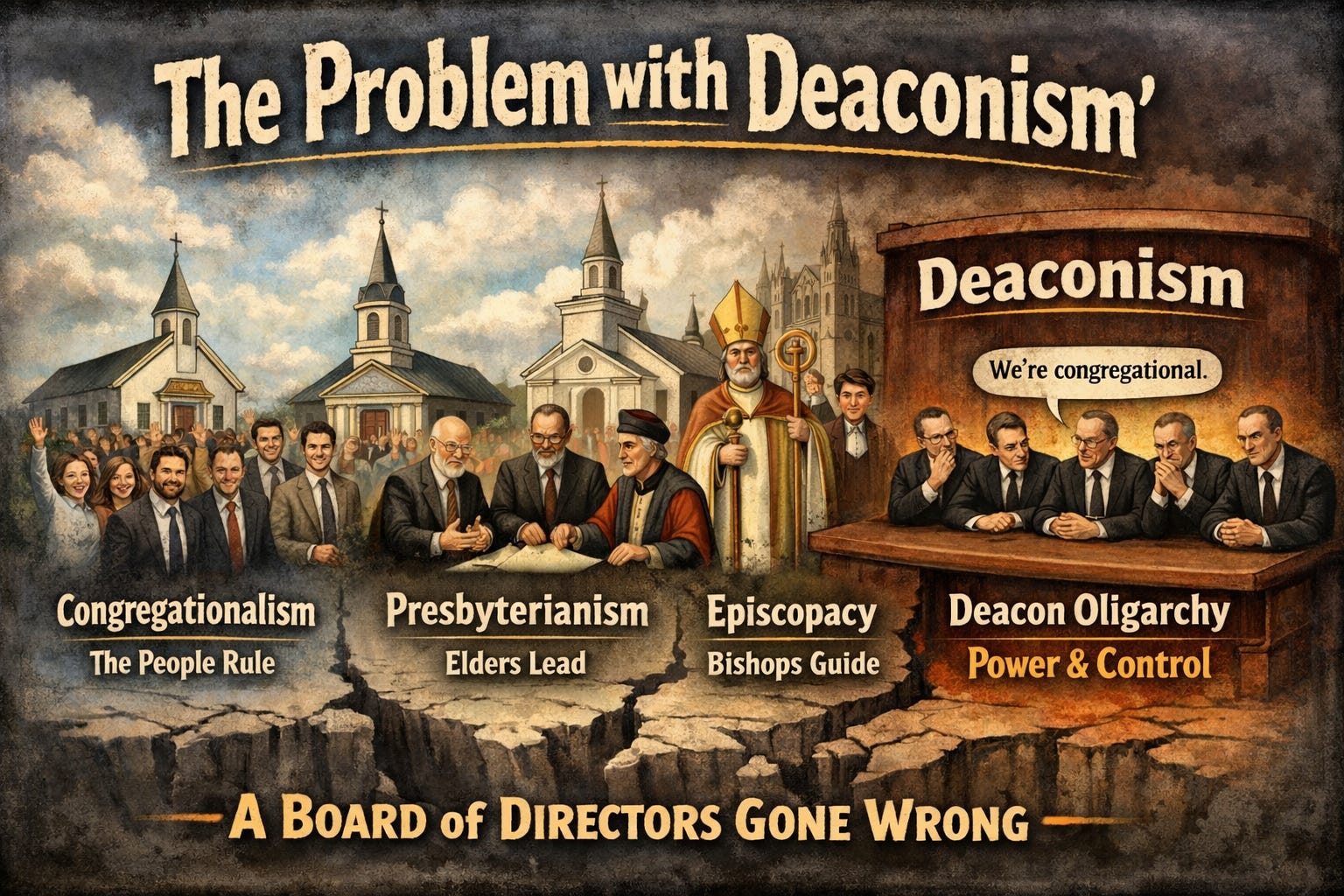
Deaconism, mistakenly labelled “traditional Baptist polity,” is probably the most common polity in America, by the number of churches practicing it. It’s impossible to say with certainty because most deaconist churches claim to be congregational. Yet, they function as an oligarchy where the deacons form a board of directors. They hire and fire the pastor and staff, set the budget and policy, and dictate the church’s vision.
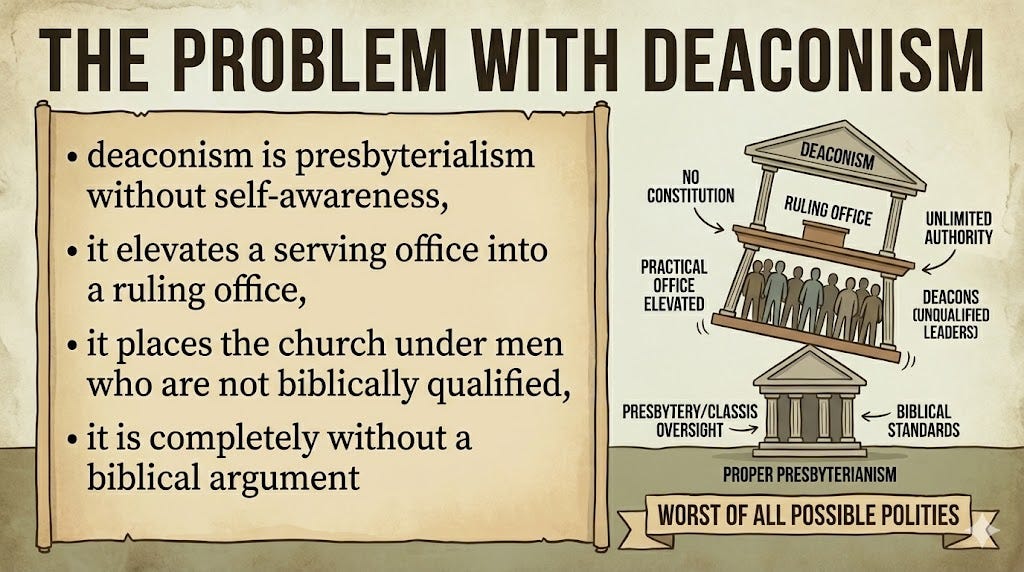
In essence, deaconism is presbyterialism (not proper presbyterianism, mind you, with presbytery or classis oversight) without self-awareness. It places men in the position of a “session” (the elders of a congregation) without requiring them to meet the biblical standards for elders. Often, deaconist churches have no constitution or by-laws limiting the terms or authority of deacons. It elevates a practical, serving office (the deaconate) into a ruling office, placing the church under the authority of men who are often biblically unqualified to lead. It is the worst of all possible polities, completely without a biblical argument for it.
The Theological Void
We can say confidently that there is no serious theological case for it because no one is making one. There is not, as far as I’ve been able to find, a single case made for the virtues of deaconism. I searched the web. Nothing. I asked Gemini for the best article defending “traditional Baptist polity” (i.e., deacon-led); it linked me to an article from Detroit Baptist University that only described it, not advocated for it.
No one, as far as I’ve been able to ascertain, has espoused deaconism as the product of biblical exegesis or theological reflection. It doesn’t even have a name until I made one up for this article. If deaconism had true believers, like Dever is to congregationalism, etc, then they would be speaking and publishing on the glories of deaconism, making their exegetical cases. But no one does. This silence confirms that deaconism isn’t a theological conviction; it is a habit.
To understand the error, one must understand the office. Biblically, deacons are servants. They handle practical needs—the music, the bank accounts, the widows—so that the elders may focus on the Word and prayer. Because it is a serving office rather than a ruling one, I believe scripture permits women deacons (Romans 16:1, 1 Timothy 3:11).
Deaconist churches, however, confuse the two. Because they treat deacons as rulers (elders), they exclude women, yet they fail to hold the men to the standard of elders. Some are so careless about polity – including a church in Pennsylvania I served at – that they have a board of “trustees,” which handles the church finances, and therefore exerts a great deal of control over the church. This office of “trustee” is completely made up, without even a fig-leaf of biblicism. The deacons then assume the role of elders. The result is pastoral anarchy.
The “Head Deacon”
I’m a witness. I moved to North Carolina nearly 20 years ago to pastor a deaconist church. I knew transitioning them to a biblical polity would be arduous. During one deacons’ meeting, the “Head Deacon” (a title ironically implying a hierarchy) announced they had a “deacons’ matter” to discuss and said I could be excused if I wanted. I wondered what a “deacons’ matter” could be—a leaky pipe? A creaky door? A pothole? I decided to stay. It turned out the “deacons’ matter” was an older man, and a former deacon, spreading malicious gossip and causing division. This was a pastoral issue, a discipline issue, and clearly in the domain of elders, like me. The deacons had usurped pastoral responsibility.
Deaconist deacons have encroached more on the pastoral office than presbyterian presbyters.
Having served at both presbyterian and deaconist churches, I can attest that a deacons’ meeting is similar to a session meeting, except that the “ruling elders” in a presbyterian church are not going to think that a discipline problem is something the “teaching elder” (i.e. the pastor) can be excused from hearing about. That is, deaconist deacons have encroached more on the pastoral office than presbyterian presbyters.
One of those deaconist deacons, “Neil,” came with us to join our Reformed plant, with a stark contrast between elders and deacons. He correctly saw that the role he used to fill – previously called a “deacon” – was biblically called “elder,” and he desired that office. There’s nothing wrong with that (1 Timothy 3:1). However, Neil proved repeatedly and spectacularly that he was incapable of biblical eldership. He once sent an email to both a trouble-making member and me about an issue I had already handled, summoning us to a meeting, as if he were the principal mediating between two fighting kids.
Neil eventually returned to his former church, where he was soon reinstalled as a deacon. He knows the polity is unbiblical. He doesn’t care. And that – that lack of interest in biblical polity – is the root problem with deaconism.
The Crisis
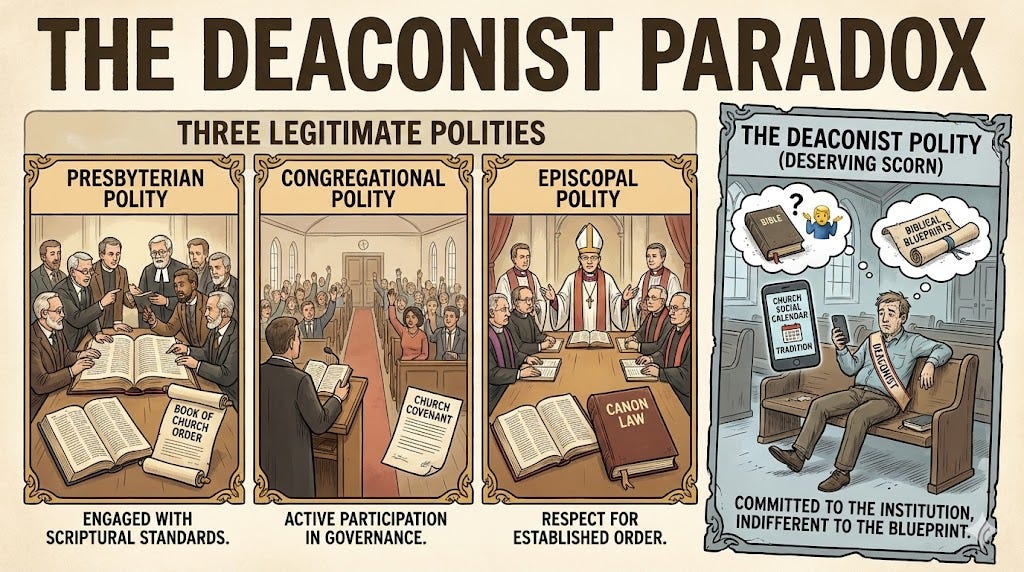
If you try to argue to a deaconist the finer points of polity, you’ll get a glazed look, as if you’re speaking a foreign language. Whatever their underlying motives, deaconists present a strange paradox: they are regular fixtures in the pews, yet they demonstrate a total lack of curiosity regarding the scriptural standards for the very institution they inhabit. They will rarely, if ever, practice church discipline because they want to be able to greet the straying member with superficial cheer if they should bump into him at Walmart. (That was an actual objection to the discipline of a man in a deaconist church.) Deaconists seem committed to the institution, yet they remain indifferent to the biblical blueprints that govern it or the intentions of its Head. That is a spiritual crisis.
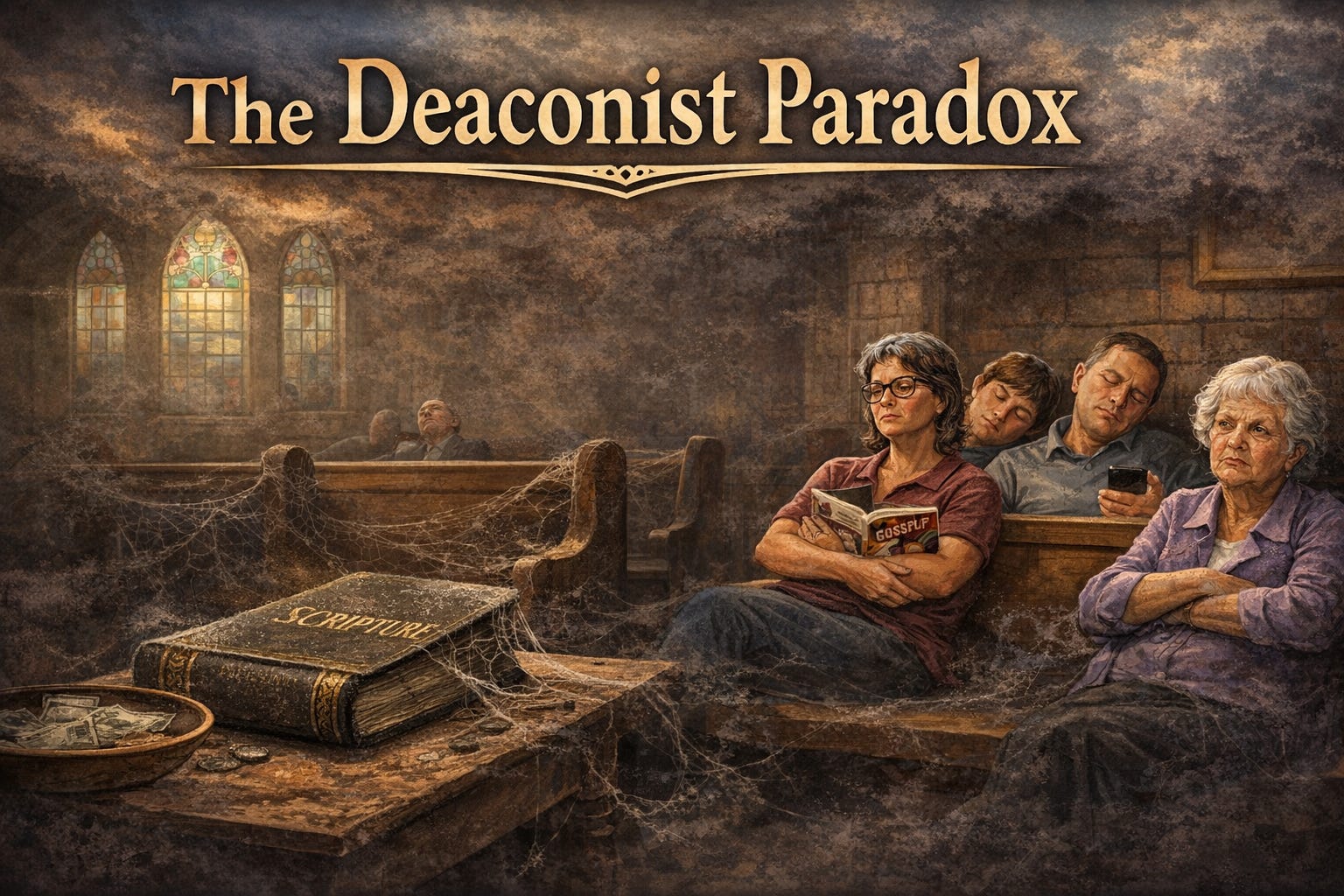
Deaconists have no interest in probing biblical polity because they have no intention of practicing it. That is the problem with deaconism, and it is as severe a problem as can be. Better to be wrong about polity but be a Berean who eagerly desires to follow God’s Word than to carry on a careless habit. I’m not fully persuaded by Adams’ presbyterianism or Stott’s episcopacy but I believe they share an earnestness that is worth following. May the deaconists learn from them.
This article is published in Theopolis.

John B. Carpenter, Ph.D., is pastor of Covenant Reformed Baptist Church, in Danville, VA. and the author of Seven Pillars of a Biblical Church (Wipf and Stock, 2022).
I have always understood the "deacon board" to be an attempt to baptize the vestry as it appeared in the Southern, colonial US, by making it sound more apostolic. Vestries had almost complete power over their local parish, locking out ministers if they preached a sermon they didn't like, picking their pay, effectively firing them, etc., without any counterweight from a bishop in North America.